
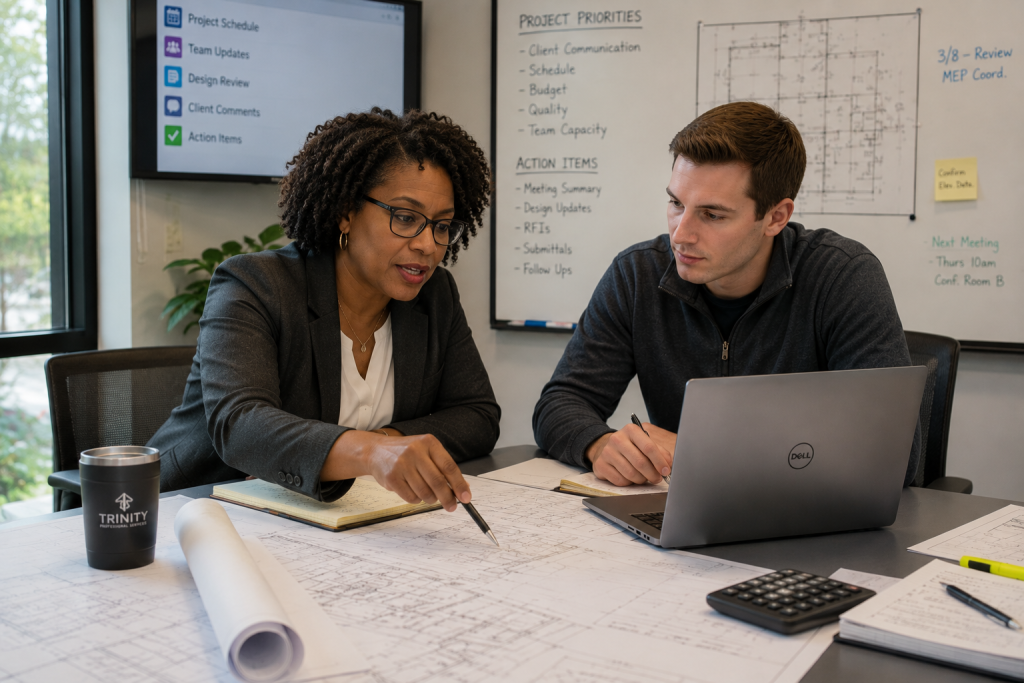
Most engineering firms today are busy. Busy with design work, emails, meetings, deadlines, staffing issues, client comments, and trying to keep projects moving.
At the same time, AI for engineering firms is becoming harder to ignore. I think a lot of people are still trying to figure out what it really is, where it actually fits, and how to incorporate it into the real day to day work.
Not in theory. In practice.
Can it help younger engineers learn faster? Can it help project managers stay more organized? Can it help teams communicate better or reduce some of the administrative overload that slows projects down?
I think the answer is yes. But probably not in the way most people think.
Younger Engineers Learn Differently Now
I remember when younger engineers would come ask me questions and one of the first things I’d ask was:
“Did you Google it first?”
Not because I didn’t want to help them. But because I believed learning how to research, think through problems, and find information was part of becoming a stronger engineer.
Before Google, we dug through manuals, design guides, old project files, and whatever resources we could find. It took time.
Now younger staff have access to AI, and that changes things.
They can ask questions differently.
They can work through ideas faster.
They can get explanations, examples, and feedback almost instantly.
That does not replace experience or engineering judgment. But it can accelerate learning if it’s used correctly.
The key is making sure people still learn how to think, not just how to generate answers.
AI Can Help With Meeting Documentation
How much time gets lost after meetings?
Someone has notes.
Someone missed the meeting.
Someone remembers the conversation differently.
Someone forgot the action items.
It happens all the time.
Project managers spend a significant amount of time trying to keep communication organized. AI can help summarize meetings, organize follow ups, and pull out action items faster.
That may sound small, but small communication gaps can turn into much bigger project issues later.
Clarity creates momentum.
Proposal Writing Still Takes Time
Most firms already have the experience. What they often lack is time.
When proposals are due, teams spend hours digging through old proposals, copying project descriptions, updating resumes, reorganizing information, and trying to meet deadlines while still managing active projects.
AI can help create first drafts, organize information, summarize project experience, and help teams get started faster.
Not final drafts.
First drafts.
Good proposals still require strategy, judgment, and experience. But reducing the administrative burden helps teams focus on the parts that matter most.
Execution is everything.
AI Can Be a Thinking Tool Too
One thing I’ve noticed personally is that AI is not just useful for automation.
Sometimes it helps flesh out ideas.
Sometimes it helps organize thoughts.
Sometimes it helps identify gaps in communication or process.
Sometimes it helps you think through a problem from a different angle.
It becomes a sounding board.
And honestly, I think that’s where a lot of the practical value is going to come from for project managers and leadership teams.
Not replacing people.
Helping people think more clearly and move faster.
The Firms That Benefit Most Will Probably Be Practical
I don’t think the firms that benefit the most from AI will necessarily be the firms chasing every new tool.
I think it will be the firms that learn how to use it practically.
The firms that combine strong operations with good judgment.
The firms that use technology to support people instead of replacing them.
The firms that stay curious and adaptable.
Because at the end of the day, AI is still just a tool.
People still lead projects.
People still make decisions.
People still build relationships.
People still carry responsibility.
And good judgment still matters.