
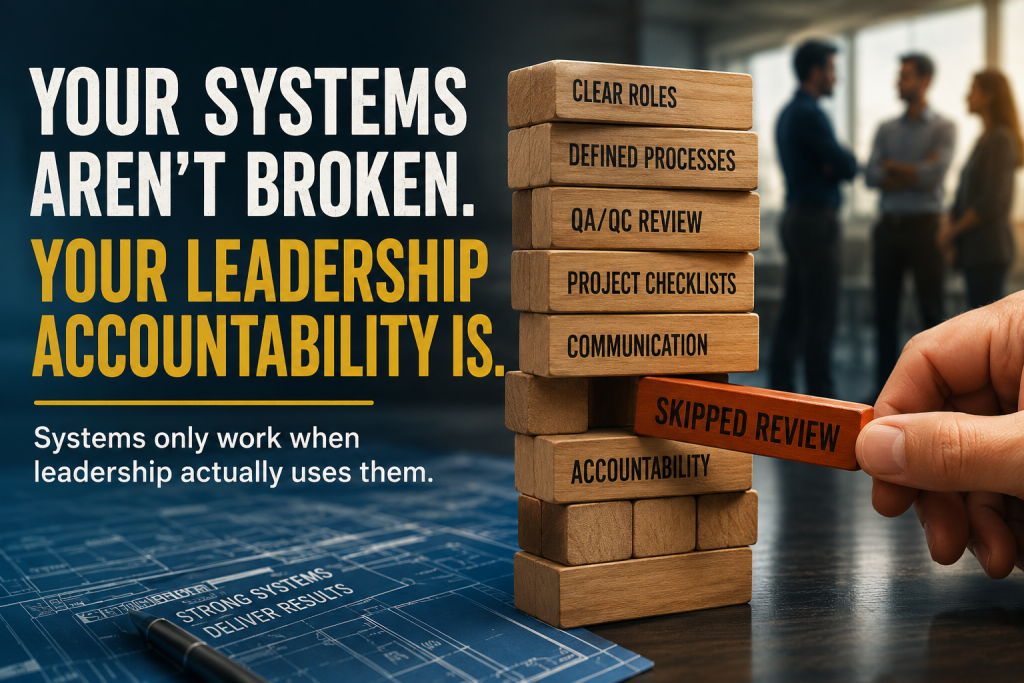
I’ve spent much of my career leading engineering and project teams and what I’ve learned is that most organizations don’t fail because they lack processes and procedures. They fail because procedures become optional when pressure shows up. They don’t have a systems problem. They actually have a leadership accountability problem.
There’s a difference.
You can have the QA/QC program, org chart and written procedures. You can develop project checklists and clearly define the roles.
Yet, things still fall apart and leadership is left wondering what went wrong.
Deadlines got tight and the QC review got skipped. Someone ended up doing work they weren’t hired for, or couldn’t fully execute the work they were hired for.
I’ll tell you what went wrong and it wasn’t system failure. Someone communicated, loudly and without saying a word, that the system was optional.
Systems Only Work When Leadership Actually Uses Them
A systems problem means you don’t have a process. A leadership accountability problem means you have the process, you built the process, you trained people on the process, and then the moment things got hard, the process got quietly abandoned.
I’ve seen it happen in firms of every size. The QA/QC program runs fine when the schedule is comfortable. The moment a deadline looms? Suddenly there’s “not enough time” for the review. The moment a key person is unavailable? Suddenly someone else is filling in for a role they aren’t fully equipped to handle.
And here’s the thing: your people are watching. Every single time.
When leadership bypasses the system under pressure, they’ve just told the entire firm that the system is a good idea in theory but not important enough to follow when it matters.
Leadership Is Layered. So Is the Accountability.
This isn’t just about the owner or CEO. Leadership accountability operates at every level of the firm.
There’s the Owner/CEO, setting the culture, the standards, and the non-negotiables. There’s the Division Manager, translating that vision into how work actually gets done within their group. And there’s the Project Manager, running day-to-day execution and making real-time decisions in the field.
Every layer of leadership shapes how the layer below it behaves.
When the Owner cuts corners under pressure, Division Managers learn that standards are flexible. When Division Managers let things slide, Project Managers learn that accountability is selective. By the time it reaches the project floor, the culture has already been established, not by the policy manual, but by what leaders actually did when it was hard.
Empowerment and accountability have to travel together. Senior leaders who empower their managers but don’t hold them accountable create a culture of unchecked discretion. Senior leaders who hold managers accountable without truly empowering them create paralysis. Both break the system, just in different ways.
The firms that consistently deliver? Research shows that organizations with strong project management complete work on schedule 63% of the time, compared to just 39% for firms with weaker practices. The difference rarely comes down to the quality of their written procedures. It comes down to whether leadership at every level actually enforces them.
The Hard Truth About Role Creep and QC Shortcuts
Let me name two patterns I see repeatedly, because they show up in firms of all sizes and they’re both leadership accountability failures in disguise.
The first is role bleed. Someone was hired for a specific function. Over time, they’re doing something adjacent, either because someone capable left and the gap had to be filled, or because a deadline forced it, or because it just seemed easier in the moment. Now you have a person executing tasks they weren’t hired for, or struggling to perform the ones they were. This isn’t a staffing problem. It’s a signal that leadership didn’t hold the line on role clarity and didn’t create accountability structures to catch the drift before it became the norm.
The second is the QA/QC shortcut. The program exists. The checklists are real. But when the deadline is tight, the review gets compressed or skipped entirely. Every time that happens with no consequence, you’ve just redefined your QA/QC standard. Not on paper. In practice.
Both patterns have the same root: leadership set a standard, then allowed exceptions. And exceptions, over time, become the new standard.
What It Actually Takes to Fix It
The fix isn’t a better checklist. It isn’t more training. It isn’t a new org chart.
It’s leaders who model the standard, especially under pressure.
That means the CEO who enforces the QC review even when it’s inconvenient. The Division Manager who refuses to let role creep slide because it’s temporarily easier. The Project Manager who escalates instead of improvises when they’re outside their lane.
It also means creating the conditions where the level below you can actually do what you’re asking. Empower your managers to hold the line. Give them the authority to enforce the process. And then hold them accountable for doing it.
If the systems in your firm only work when things are easy, they’re not really systems. They’re suggestions.
Leadership accountability is what turns suggestions into standards.
Trinity Professional Services helps engineering and project-driven organizations build the operational systems and leadership structures that perform, especially when pressure is high. If your firm has the systems but not the results, let’s talk.